Sunday, October 12, 2014

Which Celebrities do You Follow?

5 years ago. I opened my first account on Weibo just because I could follow my favourite Chinese singer Bibi Chow. After that, social media become a huge part of my life and I need to spend several hours everyday on them, not only as I can know a lot of news all around the world. Most importantly, I can follow the first hand updates from the celebrities I like. 

Undoubtedly, we feel closer to the stars’ lives since we have social media. Judging from the Twitter’s top 10 most followed accounts, we can see that there are eight of them are celebrities. People used to devour celebrity magazines or newspapers to get the latest on who is dating whom and who wore what designer to which premier. Now, people can follow Katy PerryTalor SwiftRihanna and others on Twitter, Instagram to see what they are doing right now. 
Twitter’s top 10 most followed accounts
Meanwhile, celebrities also enjoy the benefit from the groundswell. For pop stars like Lady Gaga and Justin Bieber, Twitter, Facebook and Instagram are great ways to interact with fans and update them with their latest news, concert tour dates, and general thoughts. But it can also be used as a very effective marketing tool for self-promotion. Just like Charlene Li and Josh Bernoff tell us five objectives to engage in the groundswell: Listening, talking, energizing, supporting and embracing. Many celebrities are also doing the same things on social media to build up their brands and keep their names current.

Listening & Talking
One of the biggest ways celebrities use social media to build their brand is by getting closer to their fans. Using Twitter or Instagram gives a star the chance to talk to his or her fans in a relatively safe environment. Since people love "talking to" their favorite stars, this endears celebrities to their adoring hoards even more. A retweet from someone you love is cause for celebration and it makes you think the stars you love really are just like you. Like the K-pop star Nichkhun is an activist on Twitter and he often has fan talk with his fans on Twitter. Thus it makes the fans feel like he is not just a star standing on the stage, but also can be a friend standing by their sides. 
Screenshot from Nichkhun's fan talk
Energizing, Supporting & Embracing
Celebs have plenty of opportunities to market to a captive audience on the social media. Sometimes this is done so well that fans don’t even realize it’s part of an advertising campaign! As part of Katy Perry’s 2011 California Dreams tourfans’ tweets were displayed over the Jumbo-tron during her live concert performance to get the crowd interacting with the show. For the first time ever, concert goers were welcomed to each show by giant on-stage screens that display live fan pictures and tweets from the event, giving everyone in the audience the chance to share their thoughts, excitement and anticipation before Katy appears on stage. Katy got the tweets started by tweeting the hashtag for each show the day of the event. A mini-version of Tweet-to-Screen also appeared on Katy Perry’s tour website to allow any fan anywhere in the world to participate in the excitement. This is a great way for her to get feedback on the show and gain followers she might not have had before, but it’s also ideal for strengthening fan loyalty!
 

Tyra Banks is the undisputed queen of social media. She has over a combined 11 million followers on Facebook and Twitter, and 1.2 million Instagram fans. As the founder of America’s Next Top Model (ANTM). Banks truly understands the value of groundswell and utilize it for her TV show. 
 Since the season 19 on ANTM, the scores of the contestants began to be quantitative. In years past, each week's decision came down to some fashion experts. From the cycle 19, however, the girls are scored in several areas on a scale from 1-10, with Social Media response and sentiment factoring into the overal score, The audience can vote for all the 14 models and leave comments, even a video comments on YouTube! Some comments even can be selected to appear on the show! This campaign lets the audience to fully get involved for the show and enhance Tyra's brand frame. Many fans are looking forward to seeing their comments can be showed on TV. In fact, many fan responses, including comments and video, take up a significant portion of the last few minutes of the show.
                                      
                                                      Message from Tyra - Be A Fan Judge! - ANTM Cycle 19: College Edition
Nowadays, more and more celebraties begin to use various social platforms as an important marketing engine. Celebs definitely have this social media thing down. Which celebrities do you follow?

Saturday, October 4, 2014

Alibaba- The Next Internet Giant of the World?


Last month, Alibaba, the internet trading company founded in a cramped one-bedroom flat in China 15 years ago, made its wildly successful debut on the New York Stock Exchange and stunned investors, becoming the 18th-biggest company in the world by valuation, ahead of Facebook, Amazon and eBay.

Jack Ma, the company's founder who became an internet entrepreneur and cemented his position as China's richest man with his 9% stake valued at nearly $21bn.
                                                                         Jack Ma
On the night’s Daily ShowJon Stewart even mockingly explained the company to the rest of America. It’s not quite like Amazon, the most common comparison, because it doesn’t sell stuff, it just connects buyers and sellers. It is really fun when I watched this video.
Just as the show introduces, as the largest E-commence company in China, Alibaba Group’s businesses covers different fileds on line. It is a combination business of GrouponAmazonEbayCraigslist and Paypal. However, these not all the things about Alibaba. In this information era filled with various social media, Alibaba also wants to have a share. 

Last autumn, Alibaba launched a mobile messaging app called Laiwang. It can search the people around you to chat with them and share songs, photos and videos in the social circle. In order to lure in more users onto Laiwang, chairman Jack Ma even led an headline-grabbing publicity blitz

“Smartphones have become an integral part of life,” Alibaba Group Chief Executive Jonathan Lu said in a statement. “With consumer behavior changing, Alibaba Group must follow society, technology and users down the mobile path and into the wireless era.”

According to the recent statistics, Laiwang has attracted more than millions of users so far. Although it only has Chinese version for now, it is looking ahead to get more users abroad in the future like WeChat does.

Screenshot from Laiwang 

In addition to Laiwang, Alibaba released another new social platform recently. It’s a sort of Instagram that’s based around tagging brand names that appear in your photos. Rather than making it a standalone app, Alibaba’s newest effort, called Fun, is built into its Tmall shopping app and is rolling out to users in an update for iOS and Android. Users just need to snap a photo, tag the brands you’re in, and share it within Fun and also to other social networks like Sina Weibo or Alibaba’s Laiwang. 
Screenshot from Fun

It seems that Alibaba has great ambition for grabbing share in the social media market. Nevertheless, it is still facing many different challenges. Their main rival Tencent's voice and text messaging app WeChat is nearly ubiquitous on Chinese smartphones and is growing internationally with 438 million users, up from 300 million last January. One of WeChat’s key talking points in China recently is its group chats, which many have praised for their relative orderliness. 

Besides, Fun isn’t the first brand tagging social network in China. Some similar apps like Pinco and Nicetwo competing apps dedicated to tagging brands in selfies are both doing so well. 


How to stand out from the crowd and attract more users is the one of the important things that Alibaba needs to think about. To become the next internet giant in the world? Alibaba seems still has a long way to go.

Sunday, September 28, 2014

The Power of the Internet- Good or not?

Although it has been over 6 years since Groundswell first published, it still has great guiding significance and influence for those who want to open a new door for their business in this information network era.


In Web 2.0 world, we cannot deny the power of the Internet. Because of the Internet, people all around the world can connect with each other without boundary; because of the Internet, everyone can share various information to others; because of the Internet, anyone can be the star and even get money by utilizing the power.

  Mark Zuckerberg speaks about the power of the internet and Facebook

However, on the other side, Internet also brings us some hidden dangers. One of the most impressive sentence I read in Groundswell so far is “You can’t take something off the Internet. That’s like trying to take pee out of a swimming pool.” which is Digg member Grant Robertson quoted words from a TV show. That is a very funny but suitable metaphor. For sure, on the Internet, everything spread so fast and no one cannot stop the power. Nevertheless, it also lets people’s privacy expose to the public easily. It reminds me of the recent hot news about Hollywood celebrities leaked nude pictures on line. The victims include 'The Hunger Games' star Jennifer Lawrence, supermodel Kate Upton, as well as Kirsten Dunst, horror movie actress Mary Elizabeth Winstead, and 'Downton Abbey' actress Jessica Brown Findlay. 

Due to those stars’ iCloud were hacked, their nude pictures spread all over the Internet just within several minutes. On Twitter, there are thousands of results about #CelebrityLeakedPhotos and people share the links of the photos constantly. Lawrence, Plaza, Amber Heard, and even FBI did nothing to provoke this kind of blatant violation. This is probably a terrible day for the vast majority of them.


Some search results for #CelebrityLeakedPhotos on Twitter

I understand the basic human urge behind wanting to pry into celebrities private life. But links to these pictures are bound to be plentiful, especially as more “leak,” and clicking on them only plays into the horrid game being played by the hacker — and anyone who gets their jollies violating women’s basic privacy like this. Actress and fellow victim Meagan Good said in her Instagram post 'For everyone re-posting the leaked nudes? You should be ashamed of yourselves.' As the users and participants on the Internet, people need to let the basic human decency override the instinct to see others’ privacy, and don’t let those hackers win.  


 Megan Good's Instagram

Actually it is the same goes for the common people. It is just piece of cake to google anyone on line to get his/her personal information, no matter on Facebook, Twitter or LinkedIn, even though you never known and met her/him before.

Internet provides a platform for sharing information while threatening the security of privacy. Preventing Internet violence and protecting private not only needs improving technology of social media platforms, but also needs public to maintain it conscientiously.


Sunday, September 21, 2014

Social Media in China and the U.S.: Similar but Different

20 years ago, first social media sites Geocities was created in America. The concept was for users to create their own websites, characterized by one of six "cities" that were known for certain characteristics. With decades of development, various social network like Facebook, Twitter, Instagram have totally changed people’s related way to each other. 


 Yahoo! GeoCities logo


Comparatively, although the beginning of social network in China was later than in America, it develops rapidly in recent years. Chinese Internet users are actively engaging in social media—especially home-grown social media platforms, such as WeiboRenren and Youku.

Rather than eliminate social media, restrictions on foreign websites and social media have resulted in a flourishing home-grown, state-approved ecosystem in which Chinese-owned properties thrive. YouTube, Facebook, and Twitter are blocked in China, but their Chinese equivalents are expanding. 

According to the Netpop Research in a new report called “Social Face-Off: A Comparison of U.S. and China Social Media Use.”, while the United States totals 169 million broadband users age 13 and up, that figure pales in comparison to China’s 411 million, who spend an average of 4.8 hours per weekday online, compared with 4.2 for their American counterparts.

Due to the large population and rapid GDP growth, there is no doubt that China's Internet user base is much bigger than U.S.. However, Chinese involvement on social media appears greater than US, too. Why? Here is an interesting comparison.

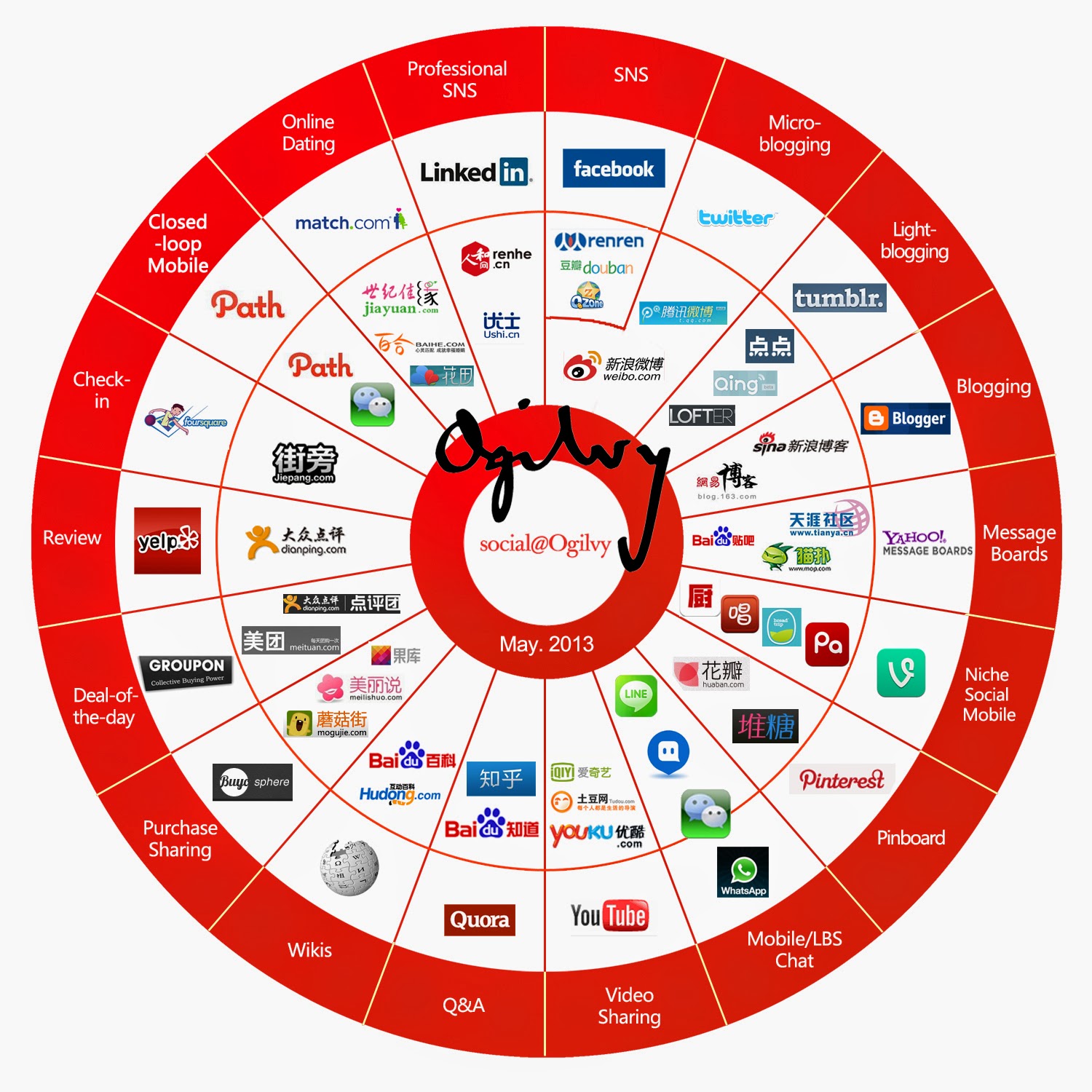
To compare the social media between China and United States, Ogilvy's 360 Digital Influence team has developed a series of social media "bulls-eyes" that place international platforms on the outside ring and their local equivalents on an inner ring (see Figure).


At first glance, Sina Weibo is a latecomer to the microblog phenomenon. But launched in 2009, just about three years after Twitter, Sina Weibo is by far the most popular microblogging platform in China. (The PRC government has blocked Twitter, though a small number of Chinese and resident expatriates hack their way around the blockage.) Similar to Twitter, Sina Weibo allows users to post 140-character messages, and users can follow friends and find interesting comments posted by others. Small but important differences in the platform have made some say it is a Twitter clone, but better. For example, unlike Twitter, Sina Weibo allows users to post videos and photos, comment on other people's updates, and easily add comments when re-posting a friend's message.

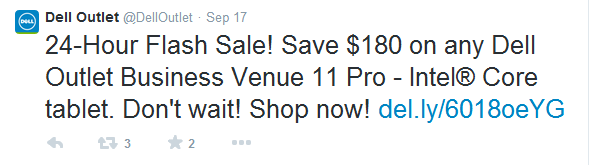
Perhaps the most striking difference between Chinese and foreign social media, however, is the length of communications expressed via microblogs in Chinese versus English. One measure is to look at what Dell Inc., a company skilled at social media, can communicate on microblogs in Chinese compared to English. Twitter holds messages to 140 characters, which is quite short in English, especially if users want to include a URL. Dell often uses its Twitter feed, @delloutlet, to promote special offers, such as this posting.


This message came in at 137 characters, almost the maximum length.

Since each character in Chinese is a word, @DellChina, Dell's Chinese-language feed, can write much more using the Chinese-language on Weibo. Like this post below, which means “Dell 7000 series Ins14PR-1848R is published now, hereby prizes! 1. The top ten who book the product can win thousand-value prize (Venue7 pad + Backpack + Cool gaming mouse), the top fifty will get ¥398-value gift (Backpack + Cool Gaming mouse) 2. Post product pictures and write good reviews will get ¥200 gift card 3. Retweet and @ 3 friends may get 1TB mobile hard disk of limited quantity! Time is limited, buy it now!”


Even with a message this length—123 characters in Chinese—there is still enough space to put in a webpage link. In other words, 114 characters in Chinese translates into 432 characters in English, well beyond the text limit of a "tweet" in English. This language efficiency turns microblogging in China into a more blog-like platform. 

Chinese social media platforms and online behaviors vary in important ways from those that may be considered their international equivalents. This variation is not all due to censorship. Some differences between Chinese and foreign social media are rooted in culture, language culture, levels of economic development, and the underlying digital ecosystem. What’s the future of Chinese social media? Let’s wait and see.